Graphic Overlays
Lexan vs. Mylar: Choosing a Film for Graphic Overlays
Every graphic overlay starts with a clear film printed on the back. Here is how polycarbonate and polyester compare, and how to choose for panels that get pressed, wiped and cleaned every day.
Quick answer
Choose polyester (Mylar) for overlays on keys and switches that are pressed thousands of times, or that face harsh cleaners and chemicals: it has far better flex life and chemical resistance. Choose polycarbonate (Lexan) for panels with little flexing, deep embossing or a tight budget: it is easier to print, form and die-cut, and usually costs less.
Key takeaways
- Both films are subsurface printed: the ink sits on the back, protected by the film.
- Polyester wins on flex life and chemical resistance, which suits membrane switches and wash-down equipment.
- Polycarbonate wins on printing, forming and cost, which suits static panels and deep embossing.
- Specify thickness, finish, windows, embossing and adhesive along with the film.
On this page +
What is a graphic overlay?
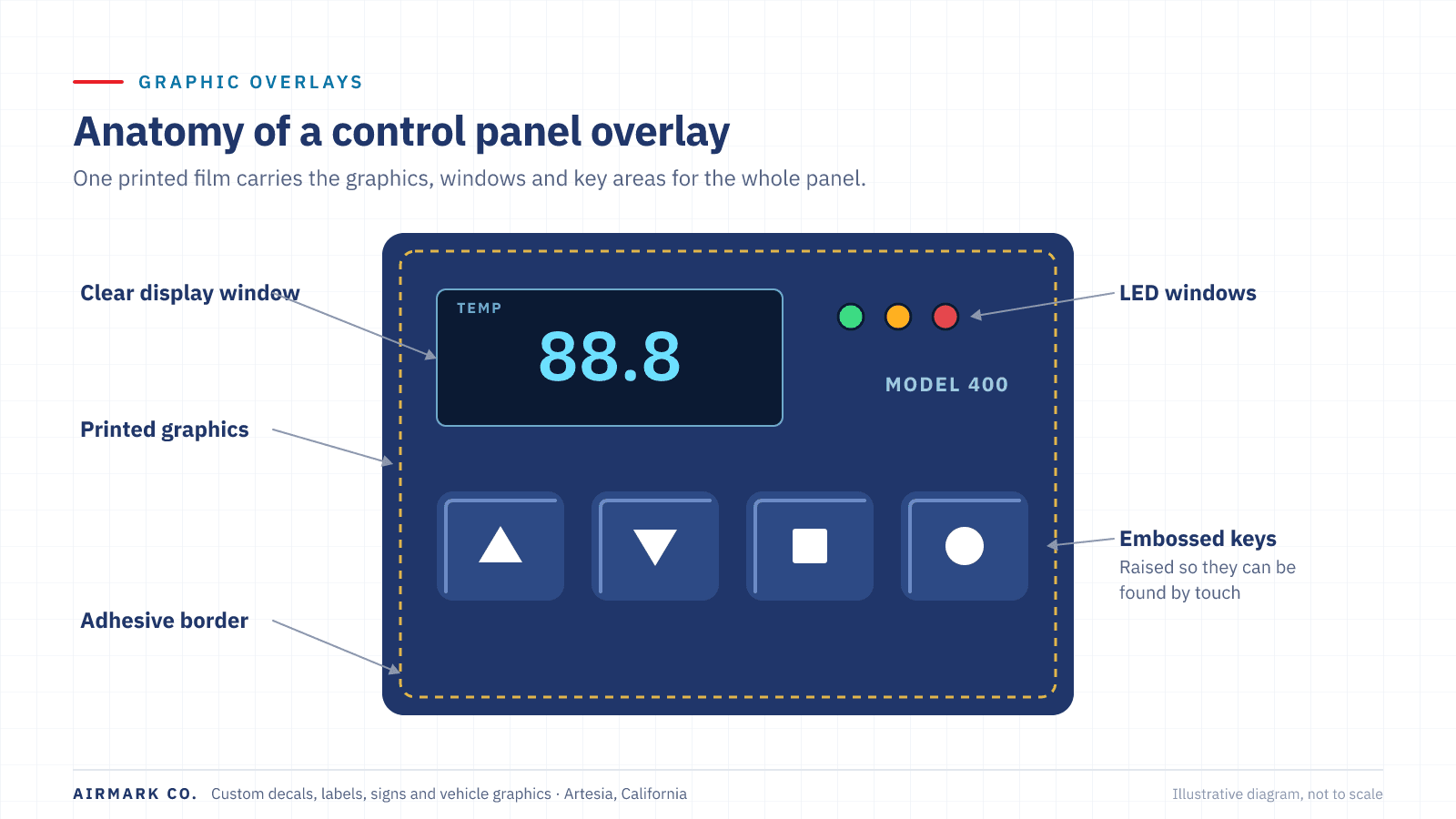
A graphic overlay is the printed face of a control panel: a thin, clear film printed on its back surface and bonded to the equipment, carrying the graphics, key legends, display windows and indicator windows the operator sees and touches.
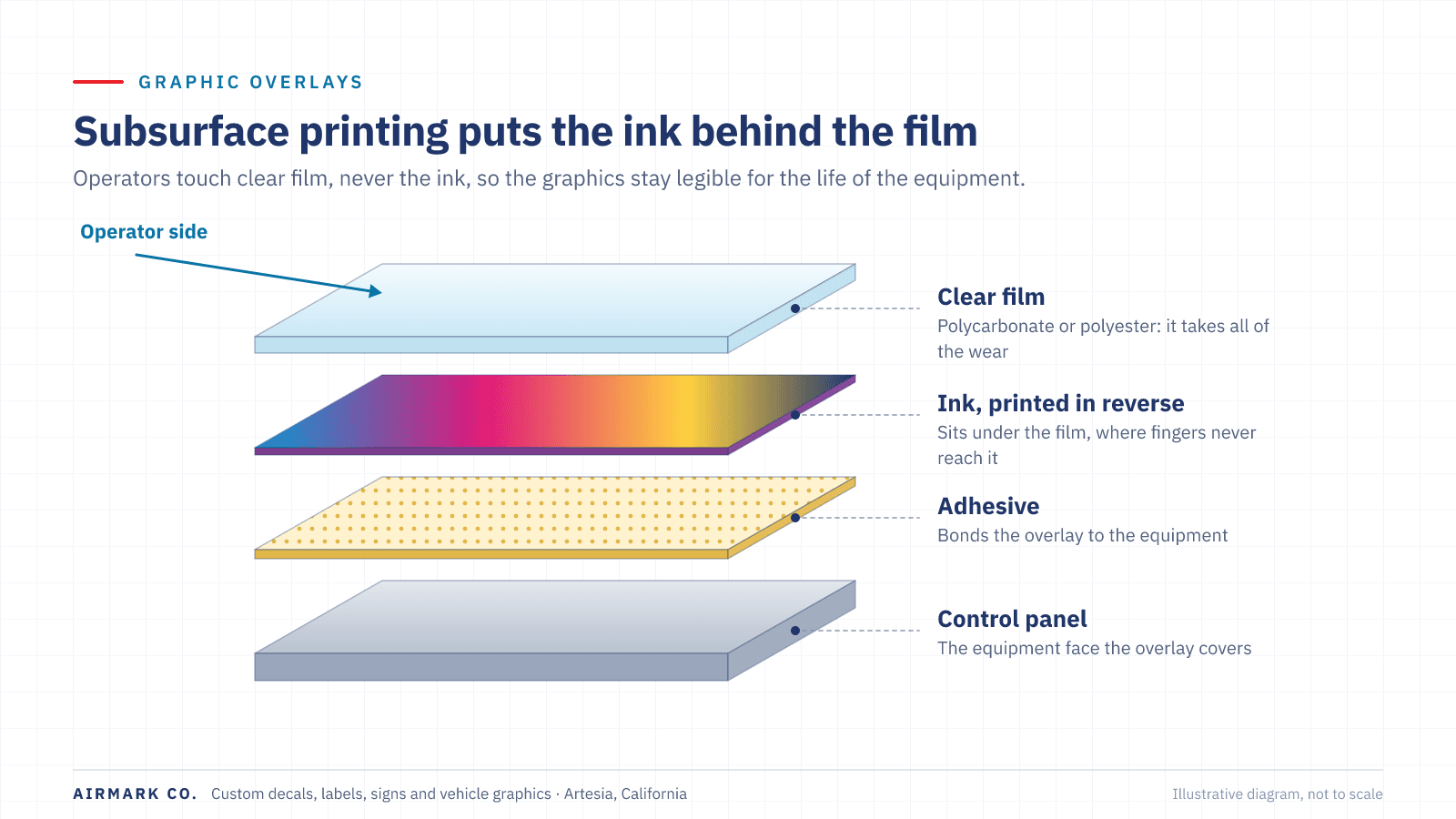
Overlays sit on everything from appliance control panels and laundry machines to industrial controls and card-payment machines. Because the ink is printed on the underside of the film, the operator only ever touches the film, which is why a well-made overlay stays legible for the life of the equipment.
Overlays can include clear or tinted display windows, LED windows, embossed keys, selective textures and a pressure-sensitive adhesive cut to fit the panel. Many sit on top of a membrane switch, where the overlay is the part the operator presses. See our graphic overlays page for what we manufacture.
What is the difference between Lexan and Mylar?
Lexan is a brand of polycarbonate; Mylar is a brand of polyester film. Polycarbonate is easier to print, emboss and die-cut, and usually costs less. Polyester survives far more flexing and resists more chemicals, which is why it dominates on switches and keypads.
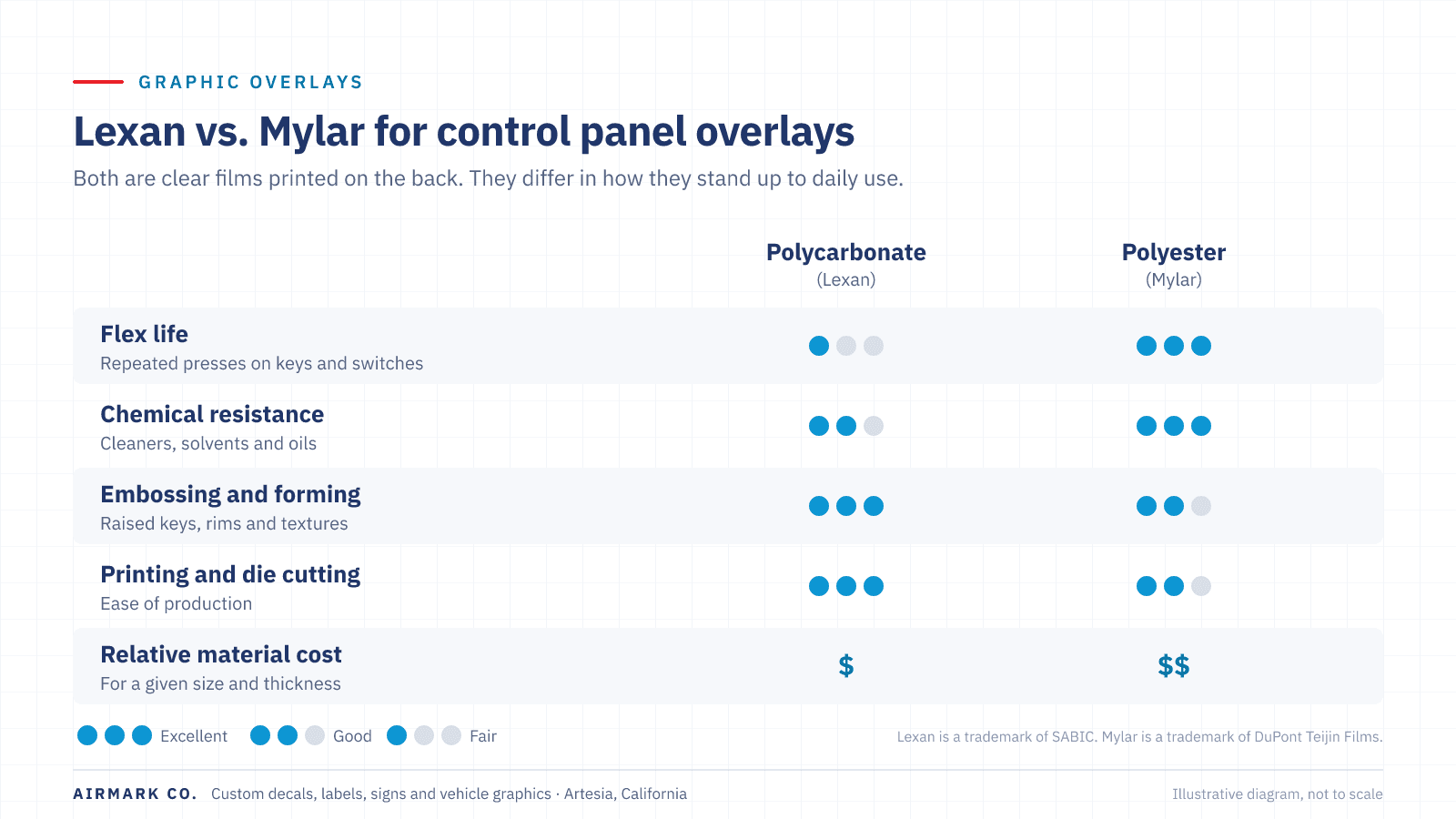
| Polycarbonate (Lexan) | Polyester (Mylar) | |
|---|---|---|
| Flex life | Fair; can crack with repeated flexing | Excellent; suits repeated key presses |
| Chemical resistance | Fair; some solvents and cleaners attack it | Excellent against most cleaners and solvents |
| Embossing and forming | Excellent; takes deep, detailed embossing | Good; embossing is shallower |
| Printing and die cutting | Easy to print and cut cleanly | More demanding; needs suitable inks |
| Typical uses | Static panels, nameplates, bezels, displays | Membrane switches, keypads, wash-down equipment |
Polycarbonate vs. polyester overlays
Both come in gloss, matte and textured finishes and in a range of thicknesses. The brand names are trademarks of their owners, SABIC for Lexan and DuPont Teijin Films for Mylar, and equivalent films from other makers are common.
Which film is better for embossed keys?
Polycarbonate forms more easily and takes deeper, crisper embossing, so it is often chosen for static panels with pronounced raised features. For keys that are pressed constantly, polyester is usually the better choice despite shallower embossing, because it will not crack from flexing.
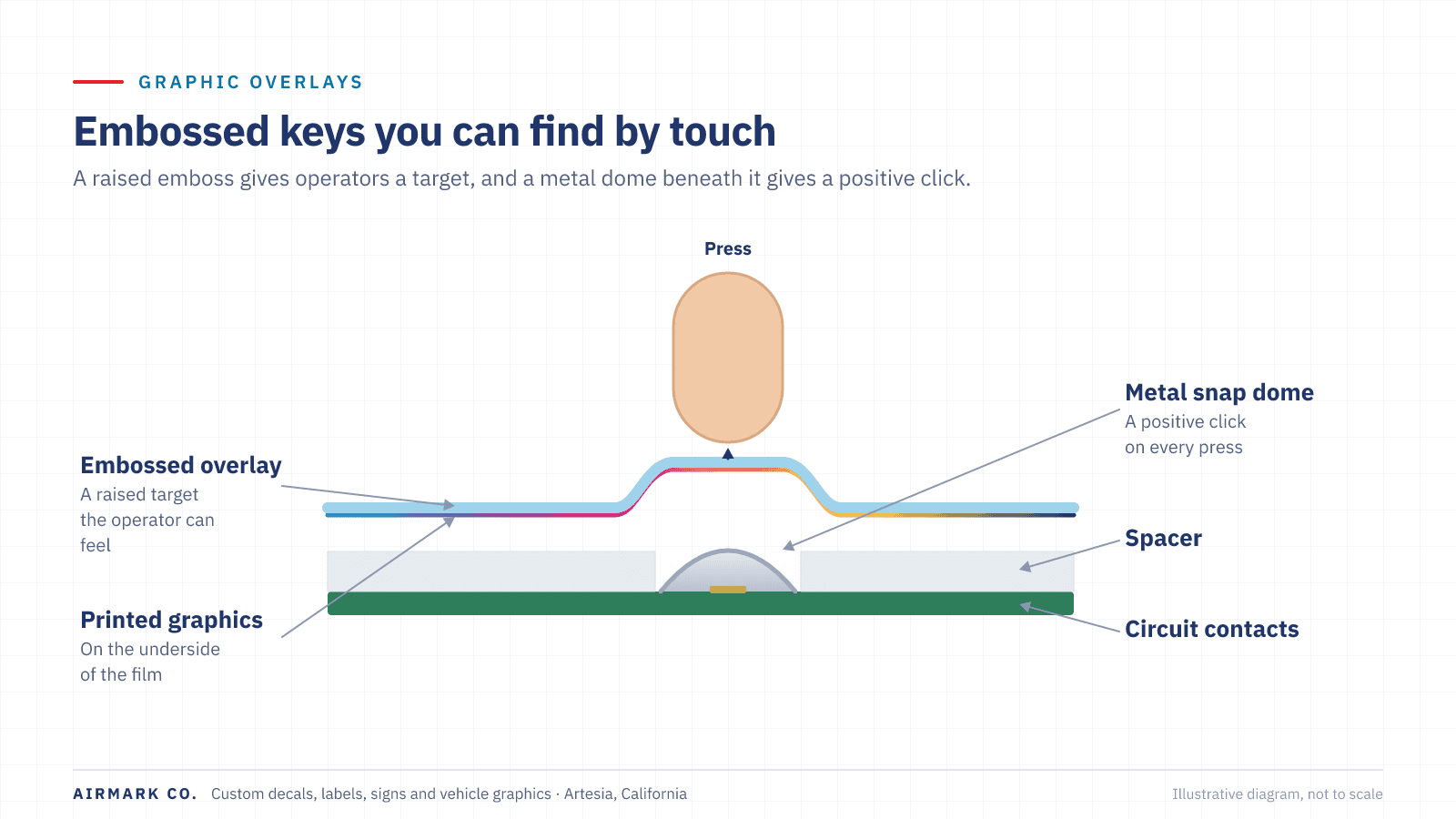
Embossing does two jobs. It gives operators a tactile target, which matters when they are wearing gloves or watching the machine rather than the panel, and it adds perceived quality. Rim embossing outlines a key; pillow embossing raises the whole key area.
Where the overlay sits over a metal dome switch, the dome provides the click and the overlay has to flex with every press. That repeated flexing is exactly where polyester’s flex life pays off.
How do you specify a graphic overlay?
Specify the film, thickness and finish; the windows and embossing; the adhesive and the surface it bonds to; and the environment the panel faces, including cleaners and chemicals. A dimensioned drawing and a sample of the panel make quoting fast and accurate.
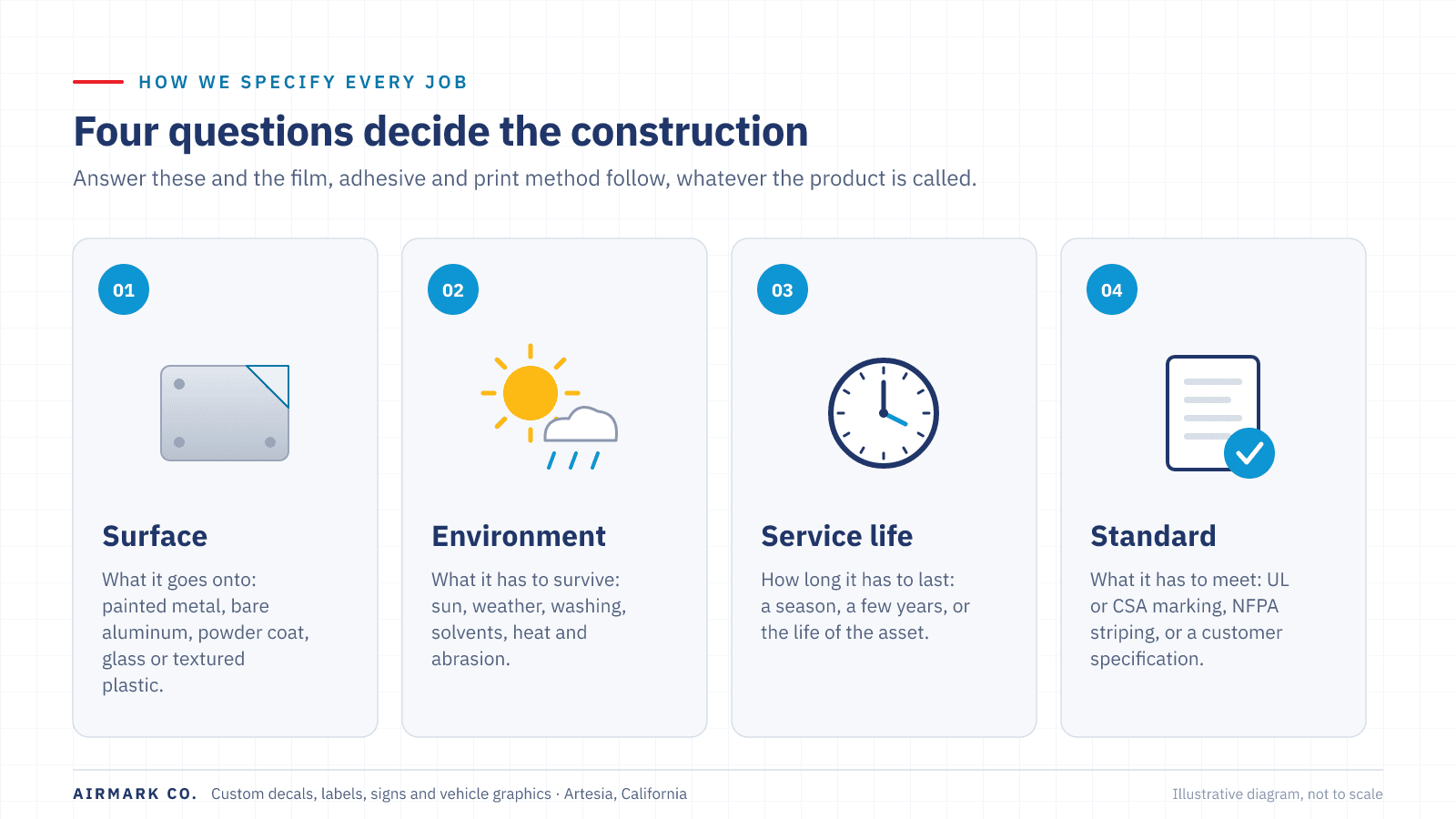
- Film and thickness: polycarbonate or polyester, typically 5 to 20 mil.
- Finish: gloss, matte or selective texture, with clear or tinted windows.
- Tactile features: rim or pillow embossing, and whether the overlay sits over domes.
- Adhesive: matched to the panel material and any texture or coating.
- Environment: cleaners, solvents, oils, UV and temperature range.
Airmark manufactures subsurface-printed overlays in Lexan and Mylar at our plant in Artesia for OEMs across Southern California and nationwide. Tell us about your panel through our quote request form, or read how we work with OEM and industrial manufacturers.
Frequently asked questions
Written by the production team at Airmark Co.
Airmark has manufactured decals, labels, signs and vehicle graphics in Artesia, California since 1948 — from a single prototype to long production runs. About Airmark