Decals & Labels
Industrial Labels for Harsh Environments: Materials and Adhesives That Last
A label that falls off or fades is worse than no label at all. Here is how to choose the face stock, adhesive and protection for labels that have to survive a factory floor, a wash-down or years outdoors.
Quick answer
Industrial labels last when every layer is chosen for the conditions: a durable face stock such as polyester, vinyl, aluminum or polyimide; an adhesive matched to the surface; and ink with a protective topcoat or laminate that resists the chemicals and abrasion the label will meet. A mismatched adhesive is one of the most common causes of failure.
Key takeaways
- Specify the label as a system: face stock, print, protection and adhesive together.
- Polyester is the durable default; aluminum and polyimide handle heat and harsh chemicals.
- Low-surface-energy plastics and many powder coats need a specially formulated adhesive.
- Subsurface printing or an overlaminate keeps print legible under abrasion.
On this page +
Why do industrial labels fail?
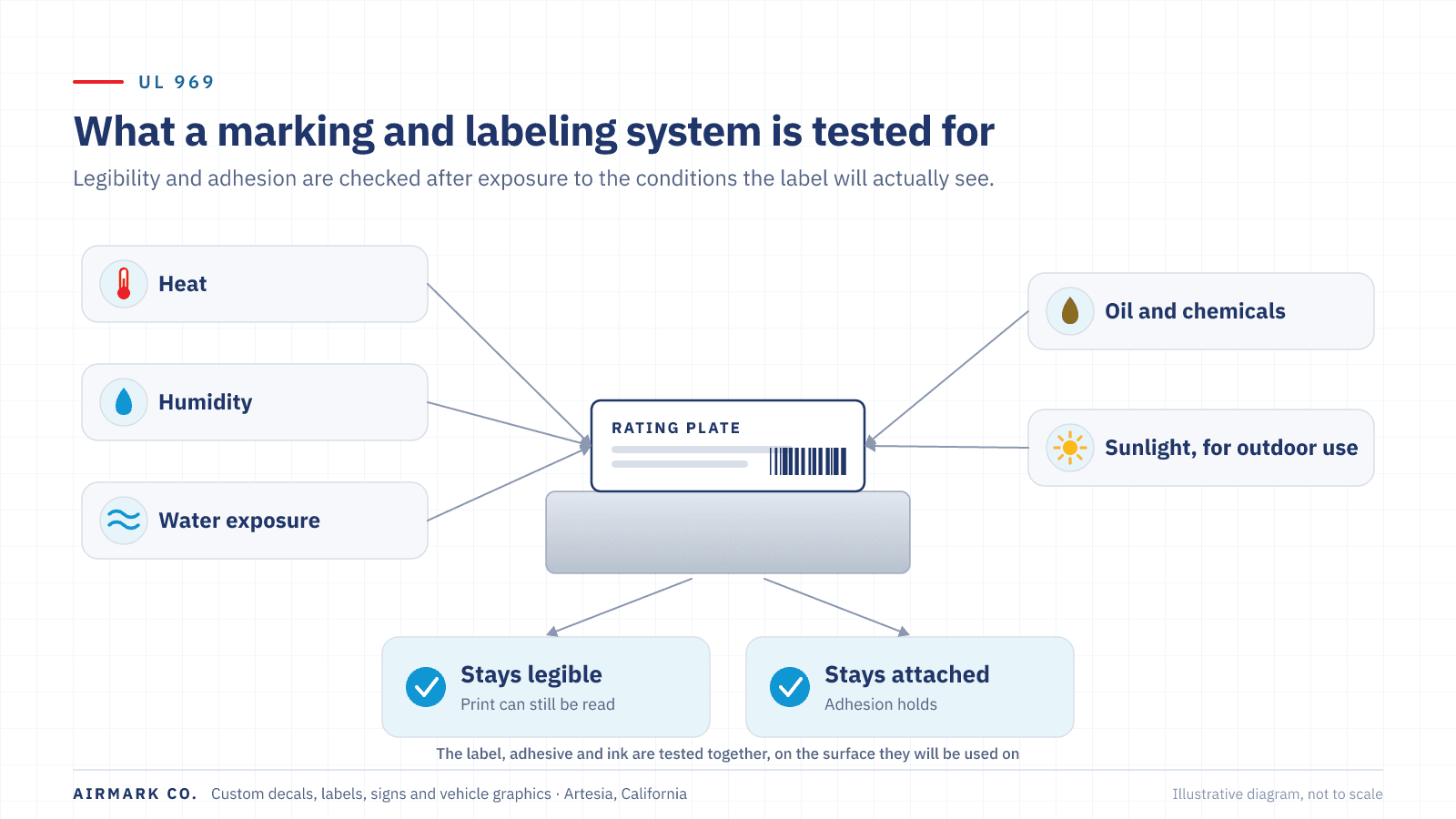
Labels fail at their weakest layer. The adhesive lets go because it was not matched to the surface, the print wears or dissolves because it was not protected, or the face stock cracks, shrinks or discolors because it was not rated for the heat, UV or chemicals it met.
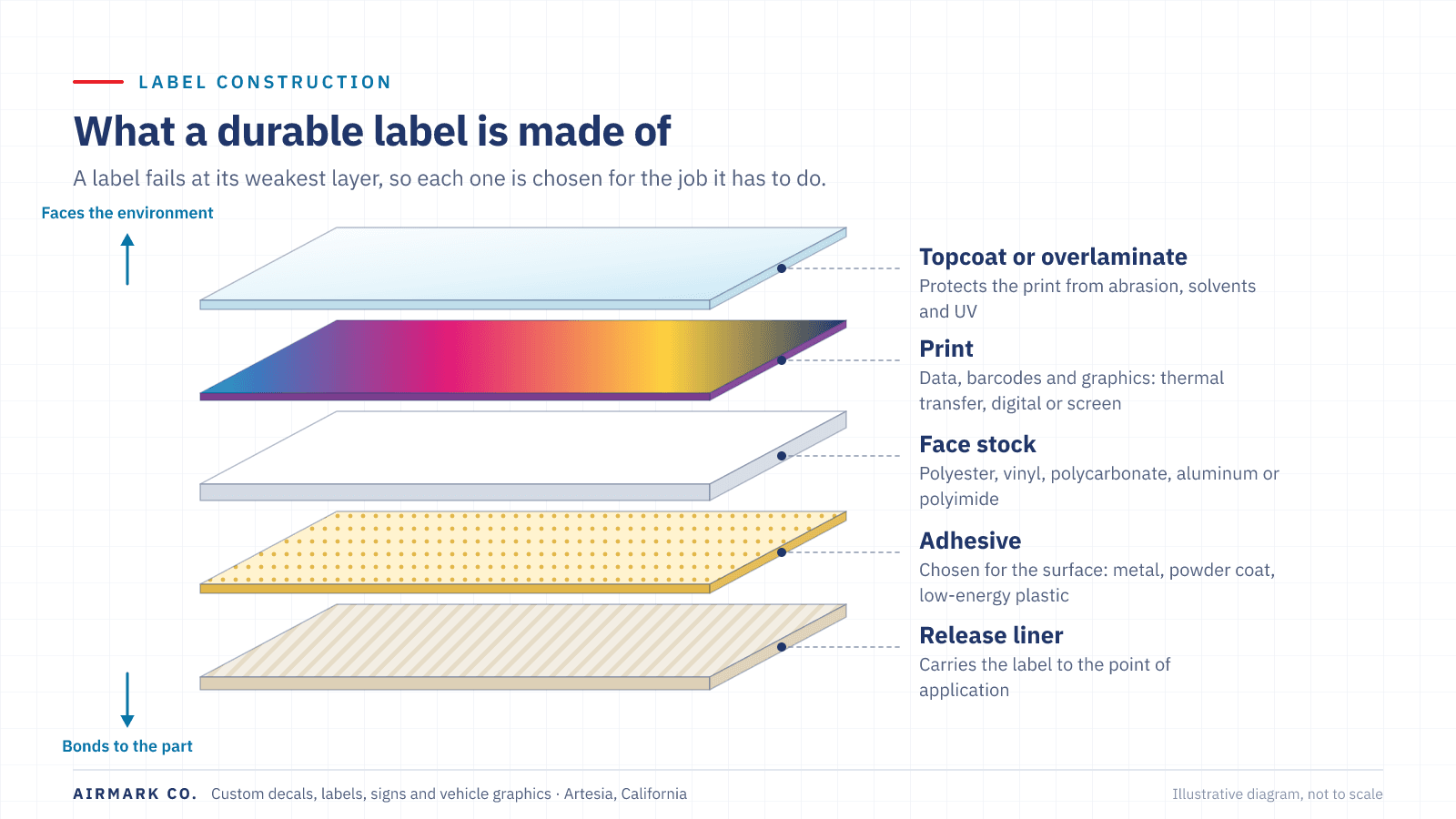
The fix is to specify the label as a system rather than a sticker. Before choosing anything, pin down the conditions: the surface material and finish, the temperature range, the chemicals and cleaning agents it will meet, whether it lives indoors or out, and how long it needs to last.
- Adhesive failure: edges lift or the label falls off, usually on low-energy plastics, powder coat, oily or textured surfaces.
- Print failure: text or barcodes smear, fade or wear away under solvents, abrasion or UV.
- Face stock failure: cracking, shrinking or discoloring from heat, cold or sunlight.
Which label material should you use?
Polyester is the durable default for industrial labels: tough, dimensionally stable and resistant to many chemicals. Vinyl conforms to curves and rivets, aluminum survives heat and harsh environments, polyimide handles very high temperatures, and paper belongs indoors.
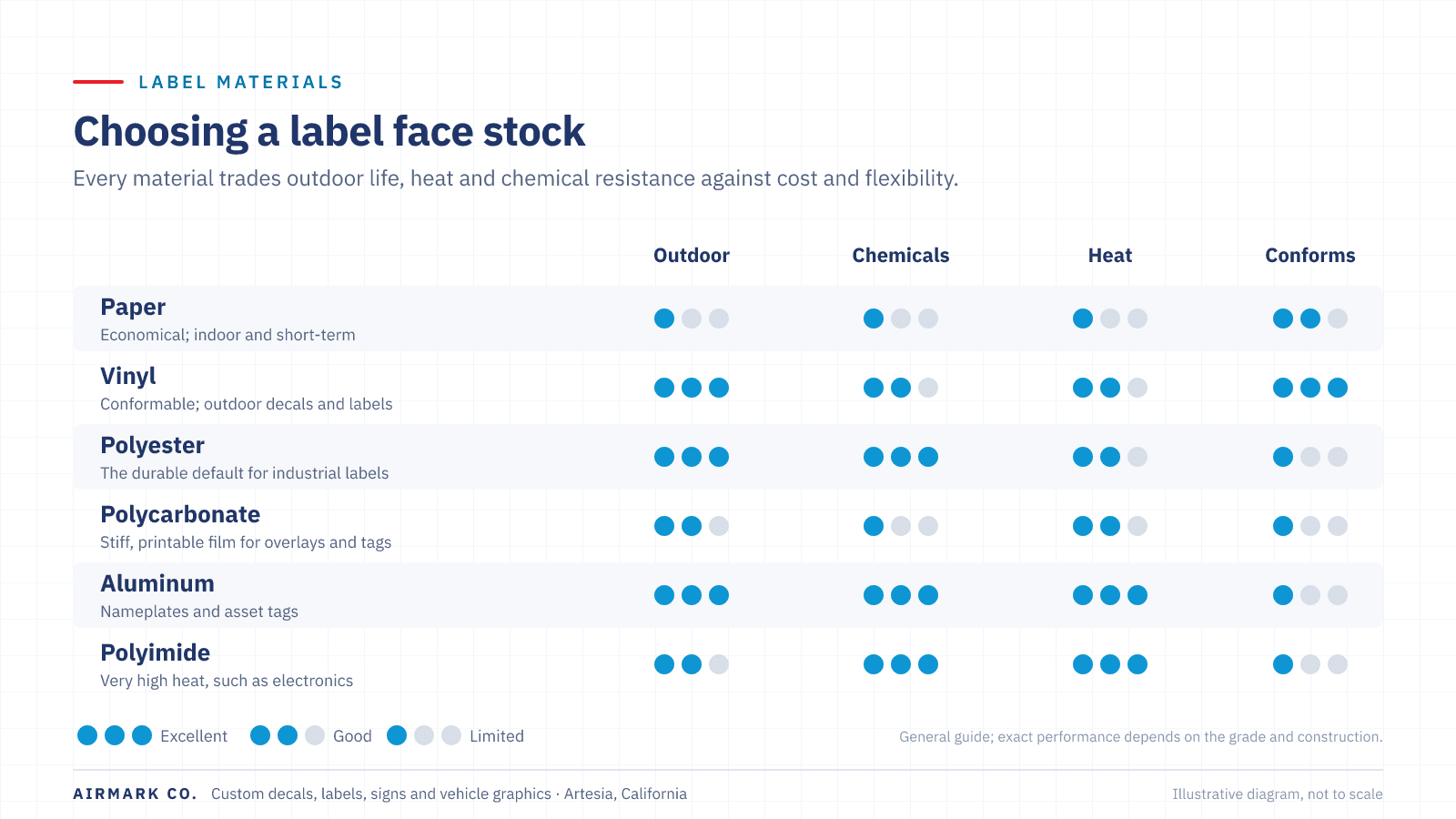
| Material | Strengths | Typical uses |
|---|---|---|
| Polyester | Tough, stable, resists many chemicals | Rating plates, asset tags, equipment labels |
| Vinyl | Conforms to curves, rivets and textures | Outdoor labels, drums, curved housings |
| Polycarbonate | Stiff, printable, can be subsurface printed | Overlays, nameplates, rigid-feel tags |
| Aluminum | Heat, abrasion and chemical resistance | Nameplates, permanent asset tags |
| Polyimide | Very high temperature resistance | Electronics and circuit board labels |
| Paper | Low cost | Indoor, short-term and shipping labels |
Common label face stocks
Our labels page lists the label types we manufacture, and materials and capabilities covers adhesives and processes in more depth.
How do you choose the right label adhesive?
Match the adhesive to the surface energy and texture of the part. Metals and glass are easy to bond; low-surface-energy plastics such as polypropylene and polyethylene, and many powder coats, need an adhesive formulated for them. Textured, curved or oily surfaces need an adhesive with more flow.
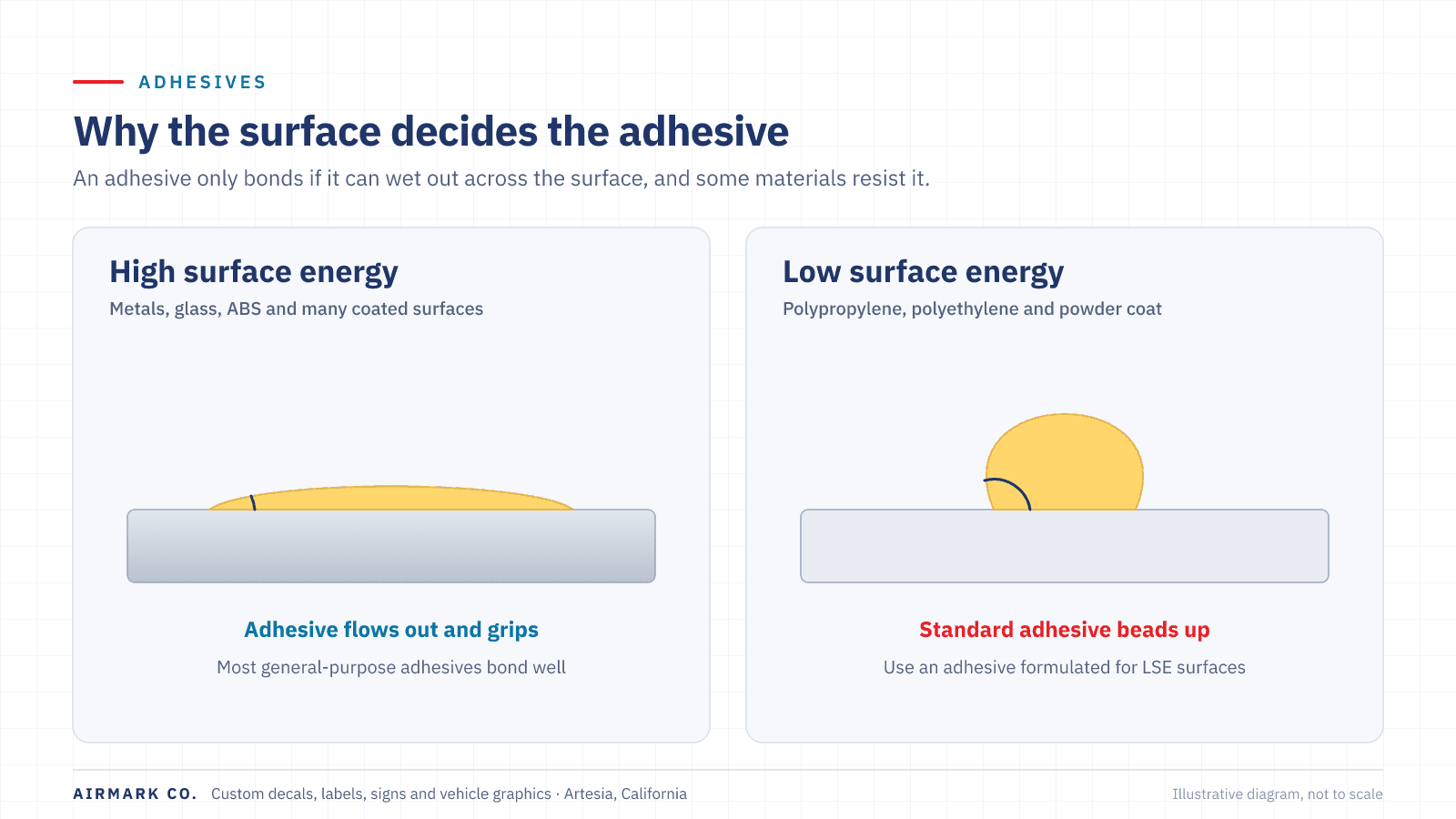
Surface energy describes how readily a liquid, including an adhesive, spreads across a surface. On bare metal, adhesive wets out and grips. On polypropylene, polyethylene and many powder coats it beads, and the bond stays weak however hard the label is pressed. Specialty adhesives for low-surface-energy materials solve that.
- Tell your label maker exactly what the part is made of, including the coating
- Mention any oils, release agents or dust present at application
- Give the temperature range at application and in service
- Ask for samples and test on real parts before a production run
How do you keep label print legible for years?
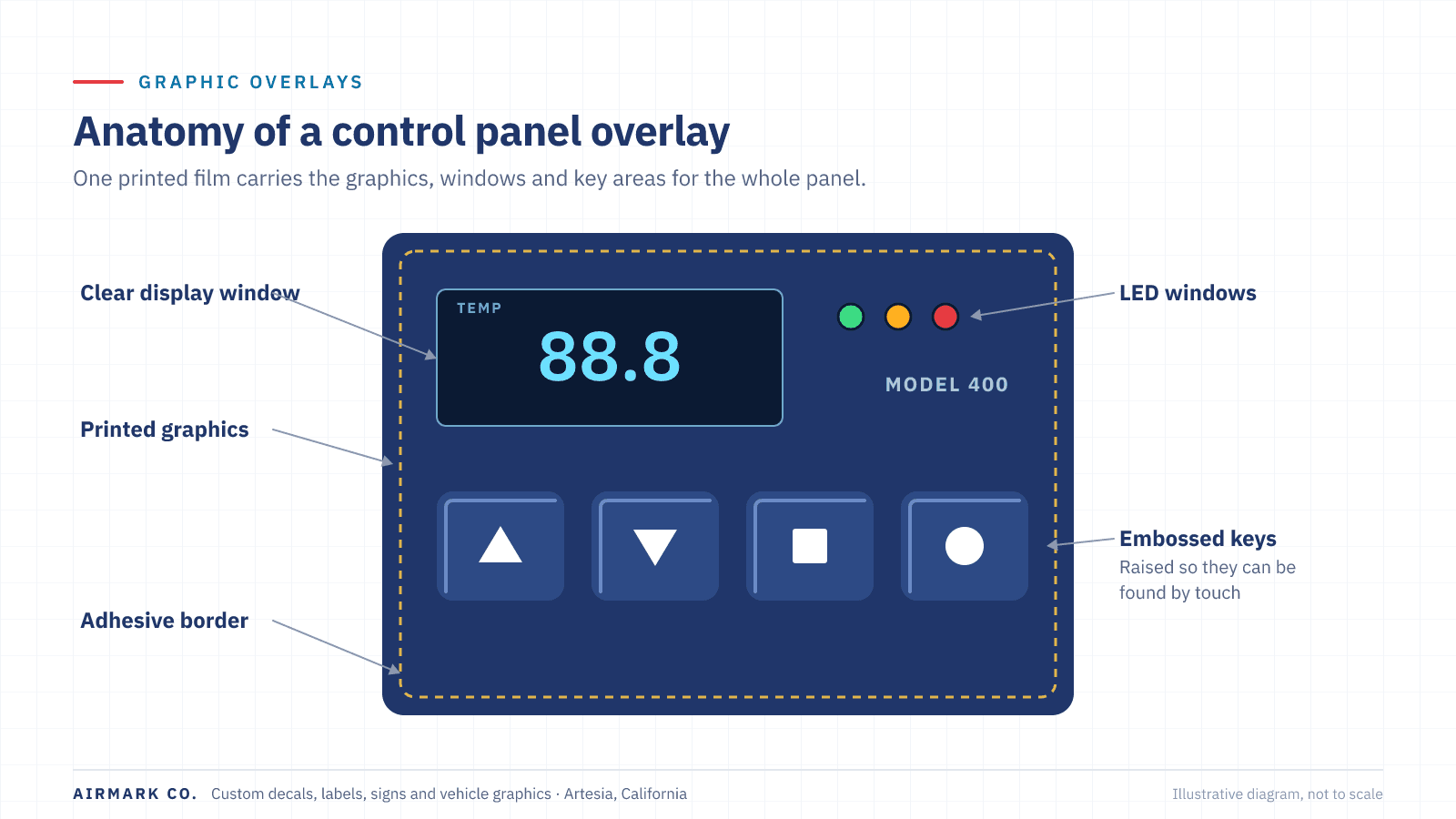
Protect it. A clear overlaminate or topcoat shields print from abrasion, solvents and UV, and subsurface printing, where the ink sits on the back of a clear film, puts the whole thickness of the film between the print and the environment.
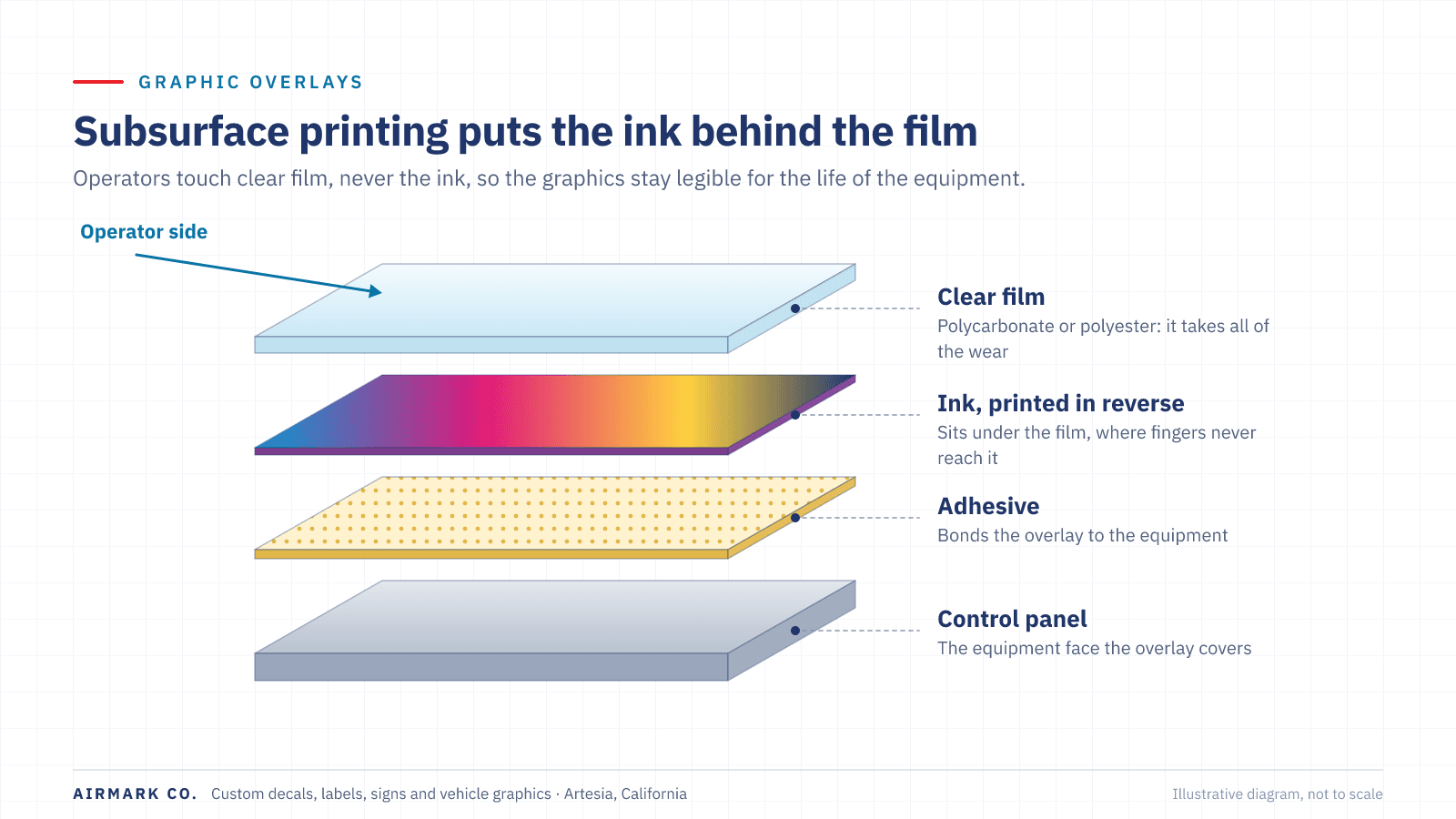
For labels that are wiped, cleaned or handled every day, such as control panels, equipment faces and high-touch asset tags, subsurface printing on polycarbonate or polyester is hard to beat. For large runs of variable-data labels, a durable topcoat or laminate over the print is often the practical choice.
Polyurethane doming is another option for nameplates and badges: a clear, raised dome that protects the print and adds a premium look. See graphic overlays for subsurface-printed panels, and our Lexan vs. Mylar guide for choosing the film.
Should your labels be serialized or barcoded?
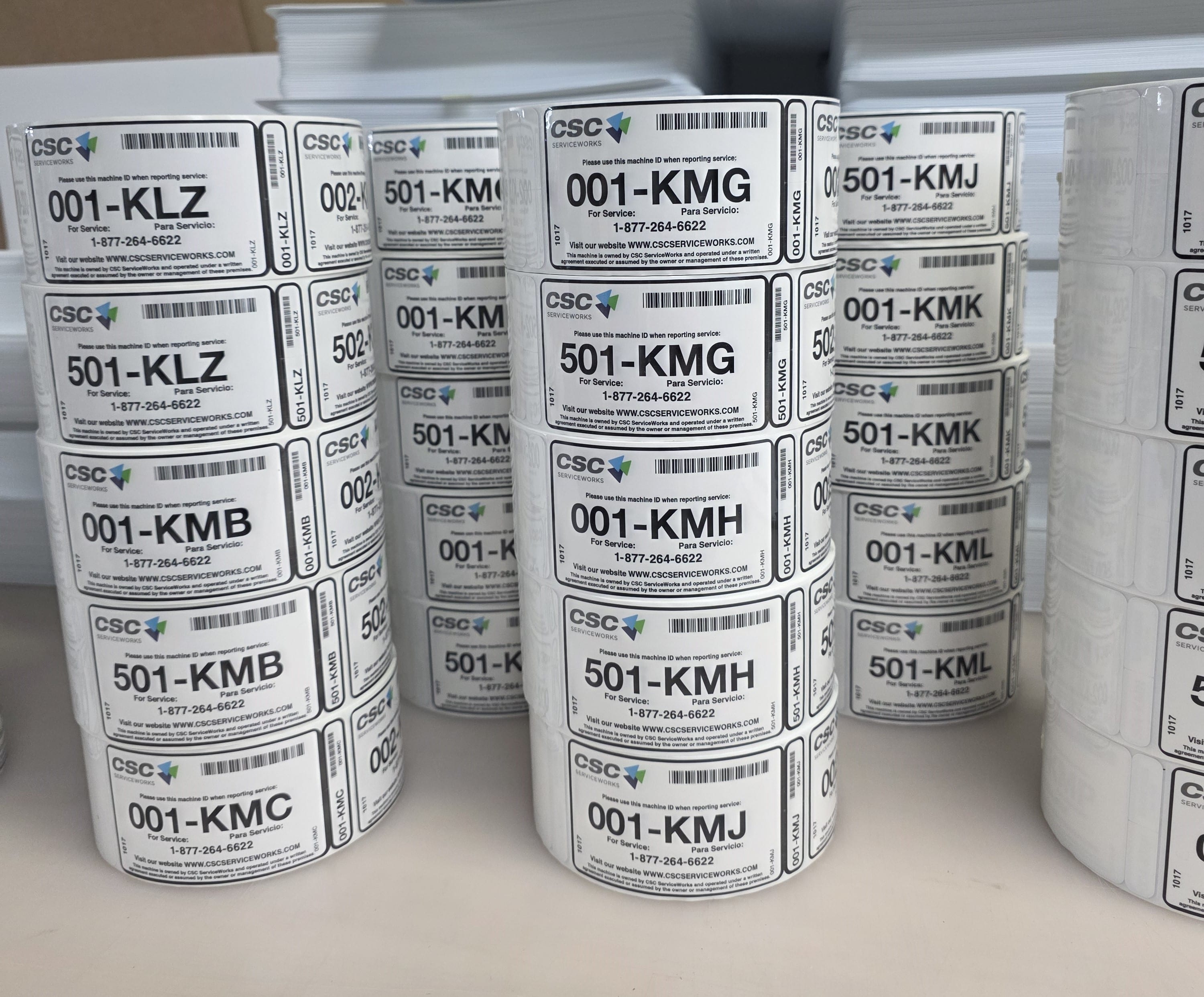
If the label identifies an individual asset, yes. Serialized labels carry sequential codes, and matching barcodes or 2D codes let each item be scanned into a maintenance, inventory or rental system without manual entry.
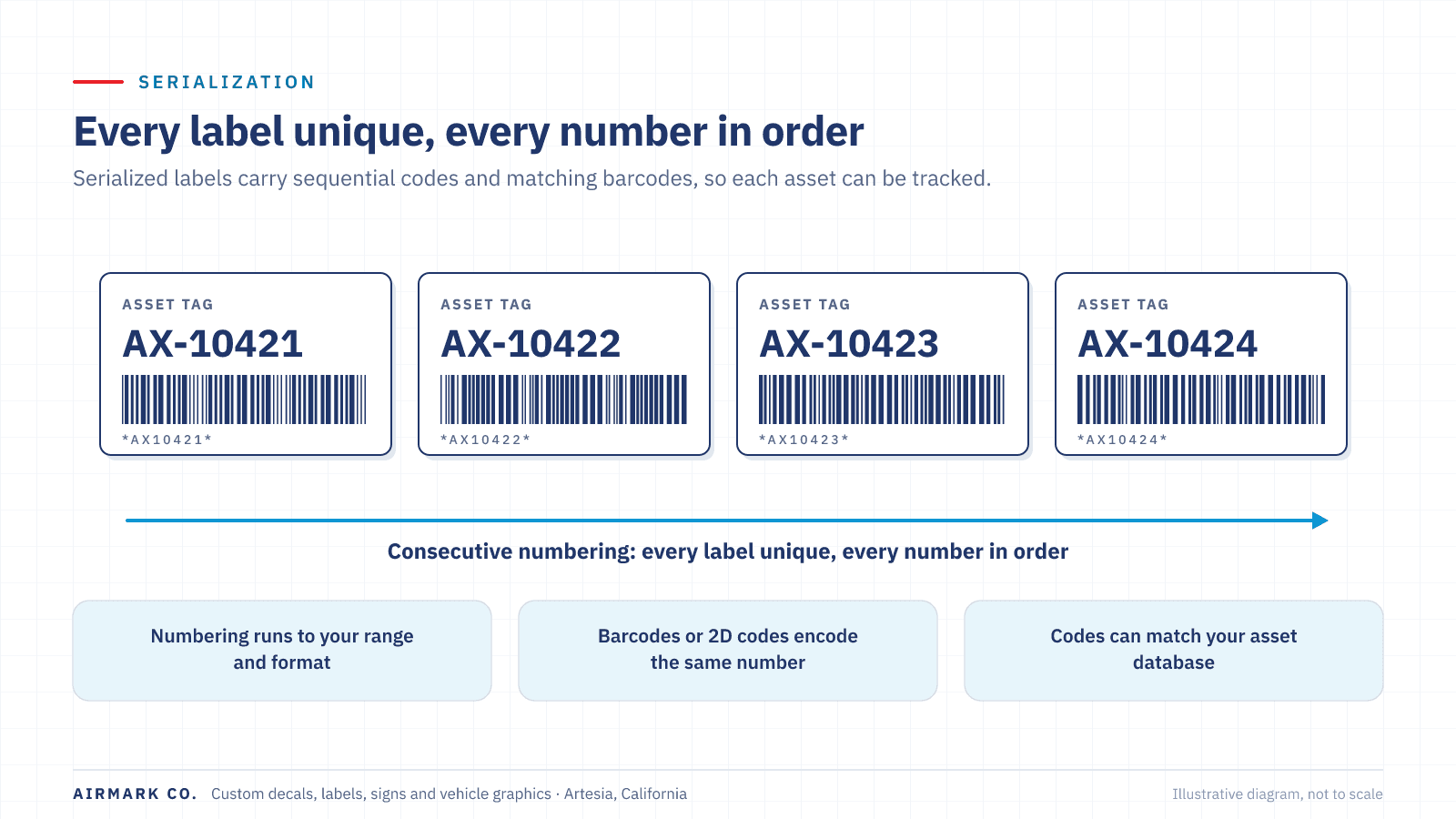
Serialized labels are common on rental equipment, laundry and vending machines, tools, IT hardware and anything tracked through a maintenance cycle. The numbering can follow your existing format and range, so labels slot straight into the system you already use.
Durability matters more here, not less: a barcode that no longer scans turns an asset back into a manual lookup. Our rental and equipment services and laundry and linen services pages show serialized labeling in practice.
Frequently asked questions
Written by the production team at Airmark Co.
Airmark has manufactured decals, labels, signs and vehicle graphics in Artesia, California since 1948 — from a single prototype to long production runs. About Airmark